




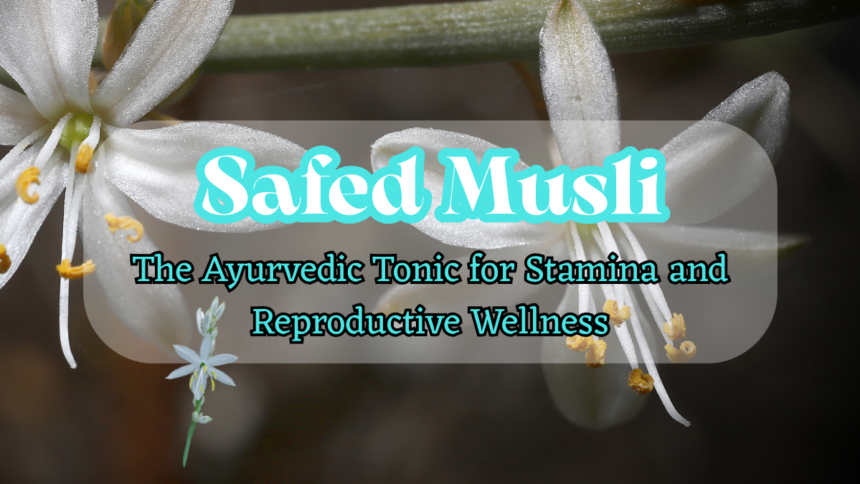
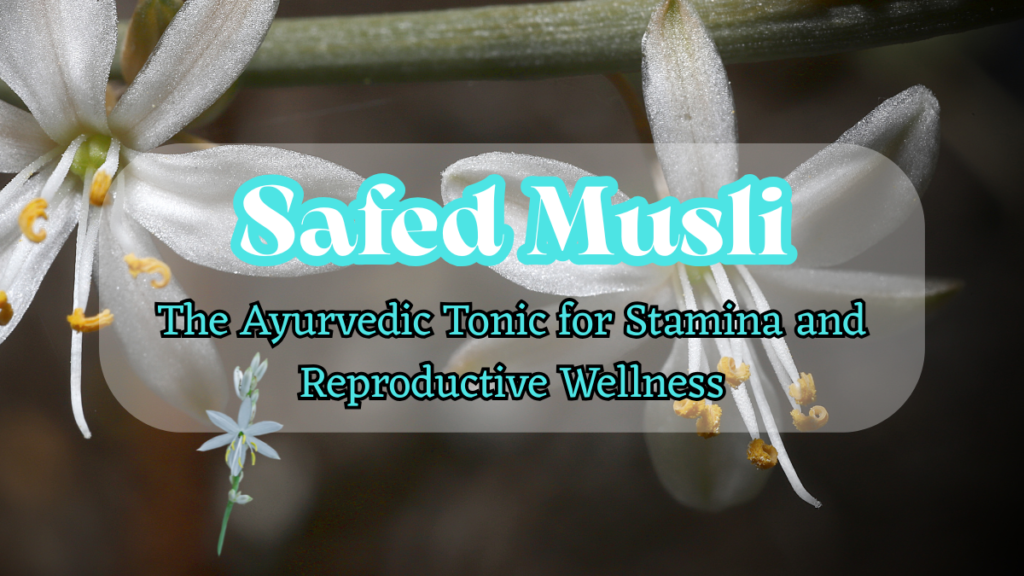
Safed Musli
A comprehensive, evidence-informed guide to Safed Musli what this remarkable Ayurvedic adaptogen actually does for stamina, reproductive health, and physical performance, with the clinical research, mechanisms, and practical protocols behind one of traditional medicine’s most valued but internationally underappreciated tonics
There is a category of Ayurvedic herb that practitioners describe with a specific phrase: Divya Aushadhi “divine medicine.” The term is not applied lightly in classical texts, and it is not applied broadly. It designates herbs considered to be so fundamentally nourishing, so deeply restorative to the body’s core vitality, that their therapeutic applications span across conditions of depletion, weakness, and reproductive insufficiency in ways that more targeted, single-mechanism herbs cannot match.
Safed Musli has carried this designation in classical Ayurvedic medicine for centuries. And yet, if you ask most people navigating the international supplement marketplace about Safed Musli, you will receive blank looks unlike ashwagandha, shatavari, or shilajit, whose international profiles have grown substantially in recent years, Safed Musli remains largely unknown outside of Indian traditional medicine practice and the specific communities of practitioners and researchers who work with it directly.
This obscurity is pharmacologically unjustified. Safed Musli has a genuinely interesting bioactive profile, a growing body of clinical research, and a traditional application scope spanning stamina, physical performance, reproductive health in both sexes, lactation support, and general vitality that places it in the same therapeutic category as several more internationally celebrated herbs, with evidence that stands up to scrutiny in ways that deserve broader acknowledgement.
This is the guide that should exist for Safed Musli.
What Is Safed Musli? Botanical Identity and Ayurvedic Classification
Safed Musli Chlorophytum borivilianum is a tuberous perennial herb of the Asparagaceae family (making it a botanical relative of both culinary asparagus and Shatavari, the premier women’s tonic discussed in an earlier article in this series), native to the tropical and subtropical regions of the Indian subcontinent, particularly prevalent in Rajasthan, Madhya Pradesh, Gujarat, and Maharashtra, where it grows in moist, forested areas under the shade of taller vegetation.
The plant produces clusters of fleshy white tuberous roots the medicinally relevant portion which superficially resemble small, white, finger-shaped sweet potatoes, connected to a central rhizome. These roots are harvested, dried, and processed into the various medicinal preparations that constitute Safed Musli’s commercial and traditional use. The name itself reflects their appearance: Safed (white) and Musli (a term referring to the fibrous or spiny quality of certain root systems) white roots.
There is an important botanical clarification required here: “Safed Musli” or “white musli” is a colloquial category that encompasses several different botanical species in regional Indian traditional practice, including Chlorophytum borivilianum (most widely used and most extensively researched in modern pharmacology), Asparagus adscendens (also called Safed Musli in some regional traditions, and arguably more closely related to Shatavari), and Chlorophytum tuberosum (another regional variant). The clinical research discussed in this article refers primarily to Chlorophytum borivilianum unless otherwise specified, and this distinction matters when evaluating commercially available Safed Musli products.
In Ayurvedic classification, Safed Musli is categorised as a premier Vajikarana (reproductive vitalising) herb and Rasayana (rejuvenative), described in classical texts as Madhura (sweet) in Rasa, Guru (heavy) and Snigdha (oily) in Guna, Sheeta Virya (cooling in potency), and specifically indicated for strengthening Shukra dhatu (reproductive tissue), increasing physical strength (Bala), enhancing Ojas (vital essence, discussed in the Understanding Ojas article in this series), and addressing conditions of depletion, emaciation, and reproductive insufficiency in both men and women.
The Phytochemistry of Safed Musli: What Creates the Therapeutic Activity
The bioactive compounds of Safed Musli that have been identified through modern phytochemical investigation encompass several compound classes, with steroidal saponins representing the primary therapeutically relevant group alongside important contributions from polysaccharides and alkaloids.
Steroidal saponins with the Chlorophytoside family (Chlorophytoside I through IV) and related spirostanol and furostanol saponins as the most pharmacologically characterised provide the primary mechanistic basis for Safed Musli’s documented reproductive and anabolic effects. These saponins share structural features with the steroidal saponins in Gokshura (discussed in the previous article), providing mechanistic overlap including gonadotropin-modulating activity, while the specific chemical structures of Safed Musli’s saponins contribute distinct additional properties relevant to its specific therapeutic profile.
Polysaccharides particularly high-molecular-weight fructooligosaccharide polymers (fructans) present in substantial quantities in the tuberous roots provide prebiotic activity relevant to gut microbiome support, immunomodulatory effects through gut-associated lymphoid tissue interaction, and possible contribution to the adaptogenic activity documented for the whole-plant preparations, given the emerging understanding of gut microbiome’s role in stress response and immune regulation discussed throughout this series.
Alkaloids including lycorine and related compounds contribute immunomodulatory and anti-inflammatory activity, with lycorine’s pharmacology extending to antiviral effects that have attracted independent research interest. These alkaloids additionally contribute to Safed Musli’s anti-fatigue and adaptogenic properties through neurological mechanisms distinct from its saponin-mediated endocrine effects.
Phytosterols including beta-sitosterol and stigmasterol provide additional anti-inflammatory activity and contribute to the 5-alpha-reductase modulating effects relevant to prostatic and androgenic applications.
This multi-class bioactive profile provides the pharmacological foundation for Safed Musli’s demonstrated activity across the diverse therapeutic applications examined in the sections that follow.
Safed Musli for Male Reproductive Health and Stamina
The most extensively researched modern application of Safed Musli is male reproductive health specifically, sperm quality enhancement, testosterone support, and the management of oligospermia (low sperm count) and related fertility challenges reflecting its classical Vajikarana designation and providing the most directly evidence-based anchor for this herb’s therapeutic reputation.
A clinical study published in the Journal of Herbal Medicine examining Safed Musli supplementation in oligospermic men over 90 days found significant improvements across multiple semen parameters: sperm count, sperm motility (both progressive motility and total motility), and sperm morphology (percentage of normal-form sperm) all improved significantly compared to baseline, with the improvements reaching clinically meaningful magnitudes consistent with improved natural fertility potential. Testosterone levels and LH levels also improved significantly, consistent with the saponin-mediated gonadotropin stimulation mechanism proposed for Safed Musli’s reproductive effects.
A separate study examining Safed Musli’s effects on sexual function in men with subclinical sexual dysfunction found significant improvements in erectile function scores, libido measures, and overall sexual satisfaction ratings on validated assessment instruments, with proposed mechanisms including the testosterone-supporting activity discussed above alongside possible direct vascular effects of saponin compounds on penile blood flow and nitric oxide-dependent vasodilation.
The physical stamina applications of Safed Musli relevant to both its sexual health use case and its broader classification as a Rasayana for general physical vitality have been examined in animal research demonstrating significant anti-fatigue effects, increased swimming endurance, and improved grip strength in Safed Musli-treated subjects compared to controls, with mechanisms proposed to involve mitochondrial support (paralleling the mechanisms discussed for Shilajit in the previous article), glycogen utilisation improvement, and reduction of exercise-induced oxidative stress through antioxidant activity.
Safed Musli for Female Health: The Underappreciated Application
Despite Safed Musli’s predominantly male-focused marketing in the contemporary supplement industry, its classical Ayurvedic applications include significant female health indications that deserve equal attention, reflecting the same principle encountered with Gokshura that herbs classified as Vajikarana in the Ayurvedic tradition were prescribed for reproductive vitality in both sexes, not exclusively for male testosterone enhancement.
The galactagogue (milk production-enhancing) application of Safed Musli represents one of its most specifically evidence-supported female health uses. Research examining Safed Musli supplementation in lactating women with insufficient milk supply found significant improvements in milk output and infant weight gain compared to control groups an application with direct physiological rationale, given that milk production (like reproductive vitality more broadly) is an energetically demanding process dependent on adequate Shukra dhatu nourishment in the Ayurvedic framework, and on sufficient reproductive hormonal support and overall maternal vitality in the modern physiological framework.
This galactagogue application directly parallels Shatavari’s documented milk-production-enhancing properties discussed in the Shatavari article in this series, and the combination of Safed Musli and Shatavari appears in classical Ayurvedic postpartum support formulations precisely because their complementary but partially distinct mechanisms of reproductive tissue nourishment and prolactin support combine to provide more comprehensive postpartum vitality restoration than either herb provides individually.
For female fertility applications, Safed Musli’s LH-stimulating and reproductive tissue-nourishing properties provide a mechanistic rationale analogous to the male fertility applications supporting follicular development, hormonal balance, and the overall reproductive physiological capacity that fertility requires, though direct large-scale clinical trial evidence specifically for female fertility improvement with Safed Musli remains less developed than the male fertility evidence and represents an important gap for future clinical research to address.
Safed Musli as an Adaptogen: The Stress-Depletion Connection
The classical Rasayana classification of Safed Musli positioning it as a foundational rejuvenative tonic rather than a targeted single-symptom herb reflects its adaptogenic properties, a dimension that has received growing research attention and that contextualises its specific reproductive and stamina applications within the broader physiological framework of stress-induced depletion and recovery.
Research examining Safed Musli’s effects on physiological stress parameters has documented reductions in stress-induced cortisol elevation, normalisation of adrenal stress response markers, and improvements in stress-related physiological parameters including body weight maintenance (stress-induced weight loss being a common accompaniment to chronic stress in the animal models used), immune function preservation, and energy metabolism stabilisation.
This adaptogenic activity is directly relevant to the reproductive health applications discussed above, because as detailed in multiple articles in this series chronic psychological and physiological stress suppresses reproductive hormone production through HPA-HPG axis interactions that are among the most consistent and well-documented mechanisms connecting mental health, stress management, and reproductive vitality. Safed Musli’s adaptogenic properties therefore support its reproductive health applications not only through direct gonadotropin-stimulating saponin mechanisms but also through the upstream stress-axis normalisation that allows reproductive endocrine function to operate without chronic cortisol-mediated suppression.
Safed Musli for General Vitality, Immunity, and Anti-Aging
Beyond the specific reproductive and stamina applications discussed above, Safed Musli’s broad Rasayana classification encompasses general vitality enhancement, immune support, and the anti-aging properties that classical Ayurvedic texts associate with its Ojas-building activity connections that the phytochemical profile supports through immunomodulatory polysaccharides, antioxidant flavonoids and saponins, and the mitochondrial energy-supporting properties relevant to cellular vitality across all body systems.
Research documenting Safed Musli’s immunomodulatory effects has found significant increases in immune cell activity, improvements in phagocytic capacity of macrophages, and enhanced natural killer cell activity directly paralleling the Ojas-immunity connection detailed in the Understanding Ojas article in this series, where immune resilience is described as one of the primary clinical expressions of robust Ojas.
Antioxidant research on Safed Musli extracts has documented significant free radical scavenging capacity across multiple assay systems, with the combined contribution of saponin, alkaloid, and polyphenolic antioxidant fractions providing comprehensive oxidative stress protection relevant to the cellular ageing processes that Rasayana classification addresses.
Classical Formulations and Compound Preparations
Safed Musli appears in several classical Ayurvedic compound formulations whose clinical application extends beyond what single-herb use provides. Musli Pak a traditional compound preparation combining Safed Musli with milk, sugar, ghee, and a range of complementary herbs including Ashwagandha, Shatavari, Kaunch Beej (Mucuna pruriens), and various spices represents one of the most commonly prescribed compound preparations for male reproductive vitality and postpartum recovery, combining the complementary mechanisms of multiple Vajikarana herbs within a fat-containing vehicle that supports bioavailability of the steroidal saponin fraction.
The combination of Safed Musli with Ashwagandha is particularly pharmacologically coherent, combining Safed Musli’s direct gonadotropin-stimulating and reproductive tissue-nourishing properties with Ashwagandha’s cortisol-reducing and HPA axis-normalising adaptogenic activity addressing both the upstream (stress-HPA suppression of reproductive hormones) and downstream (direct reproductive tissue nourishment and gonadotropin stimulation) dimensions of reproductive vitality depletion simultaneously.
Conservation Status and Ethical Sourcing
A dimension of Safed Musli that any comprehensive discussion must address is its conservation status Chlorophytum borivilianum is classified as a threatened species in its natural habitat due to decades of over-harvesting driven by commercial demand that has significantly exceeded the capacity of natural populations to regenerate. This ecological context creates both a practical supply chain challenge and an ethical consideration for consumers and manufacturers engaged with this herb.
Responsible Safed Musli sourcing therefore requires cultivation-sourced material rather than wild-harvested product, from manufacturers who can document sustainable cultivation practices and who provide supply chain transparency appropriate to sourcing from a threatened species. This is not a peripheral consideration it is a fundamental ethical dimension of using this herb responsibly, and it should influence purchasing decisions in ways analogous to, if not as prominently discussed as, similar sourcing considerations for other threatened medicinal plants.
Practical Use: Forms, Dosing, and Integration
Safed Musli is available primarily in two forms for therapeutic use.
Safed Musli churna (powder): 3–5g of dried root powder, typically taken with warm milk and honey, once or twice daily. The traditional preparation in milk specifically supports bioavailability of the fat-soluble saponin fraction a preparation rationale directly analogous to the turmeric-fat combination discussed in the turmeric and curcumin article. This traditional preparation is particularly appropriate for the general vitality, postpartum recovery, and lactation enhancement applications.
Standardised extract capsules: 500–1,000mg daily of standardised extract (specifying saponin content, ideally with Chlorophytoside quantification for the species-specific marker compounds), used in most clinical research and providing the most consistent dosing for reproductive health and performance applications.
Duration: consistent with the Rasayana classification and the gradual tissue-nourishing mechanisms involved, meaningful improvements in the reproductive, stamina, and vitality parameters documented in clinical research required 60–90 days of consistent daily use establishing realistic expectations for onset of benefit that differ from acute pharmacological interventions.
Safety Profile
Safed Musli’s safety profile across traditional use and clinical monitoring is generally favourable, with no significant adverse effects documented in available clinical research at standard doses. Considerations include: its cooling Virya may require attention in individuals with predominantly Vata or cold-constitution presentations where prolonged cooling herb use may need balancing; its reproductive hormone-modulating effects warrant medical discussion before use alongside pharmaceutical hormonal treatments; and the conservation status discussed above makes ethical sourcing a practical safety consideration in the broad sense of ensuring product authenticity.
The Honest Bottom Line
Safed Musli’s international obscurity relative to its Ayurvedic significance and growing clinical evidence base represents one of the more puzzling gaps in the contemporary natural medicine awareness landscape. An herb with documented clinical evidence for sperm quality improvement, testosterone and LH support, galactagogue activity, adaptogenic stress modulation, and general immune and vitality enhancement supported by a pharmacologically coherent multi-mechanism profile and a classical Rasayana designation reflecting centuries of empirical clinical observation deserves considerably more attention than it has received outside of specialist Ayurvedic practice.
For those navigating the specific health challenges that Safed Musli most directly addresses male reproductive health, postpartum recovery and lactation, general vitality depletion from chronic stress, and the kind of deep fatigue that standard supplements have not resolved this herb’s combination of traditional specificity and growing modern evidence makes it a genuinely worthwhile addition to the integrative health toolkit.
The divine medicine of classical texts is available today, properly cultivated, ethically sourced, and increasingly research-validated. The question is simply whether you will give it the attention its evidence has earned.
Did this comprehensive guide to Safed Musli introduce you to a herb that deserves far more recognition than it has received? Share it with someone navigating reproductive health challenges, postpartum recovery, or chronic vitality depletion who might benefit from knowing about this underappreciated Ayurvedic tonic. Leave a comment with your own experience with Safed Musli, or subscribe to our newsletter for more deeply researched content giving Ayurveda’s less internationally celebrated herbs the evidence-based attention they deserve.