


Manjistha
A comprehensive, evidence-informed guide to Manjistha the red-rooted Ayurvedic herb whose Rakta Shodhana (blood purification) tradition is now explained by anthraquinone pharmacology, lymphatic support, and documented anti-inflammatory skin mechanisms
She had spent four years and a considerable amount of money trying to address the hyperpigmentation that had developed across her cheeks and jawline a combination of post-acne marks, uneven skin tone, and what her dermatologist had described as melasma, possibly triggered by a combination of sun exposure and the oral contraceptive she had been taking for the previous three years. She had tried vitamin C serums, niacinamide, alpha-arbutin, a prescription azelaic acid formulation, and a brief, unpleasant experience with hydroquinone that her skin had reacted to poorly. Each intervention produced marginal, inconsistent improvement. The underlying unevenness persisted.
An Ayurvedic dermatologist she consulted spent more time asking about her digestion, liver health, menstrual cycle, and stress levels than about her skincare routine and then explained something that reframed her entire approach to the problem. “Your skin,” he said, “is showing you something about your blood and your lymph. The way your body is managing inflammatory byproducts, hormonal metabolites, and the waste products of cellular activity is directly expressing itself on your face. We do not treat the surface. We treat what the surface is reflecting.”
He prescribed Manjistha. Three months later, her skin had cleared more substantially than in the preceding four years of topical treatment.
This is Manjistha: the herb that Ayurveda’s classical texts consistently place at the centre of its Rakta Shodhana (blood purification) tradition, and whose pharmacological mechanisms when examined through the lens of modern research reveal a genuinely coherent, multi-pathway explanation for why addressing the internal biochemical environment produces the skin clarity that topical treatments applied to the surface alone frequently cannot achieve.
What Is Manjistha? Botanical Identity and Classical Significance
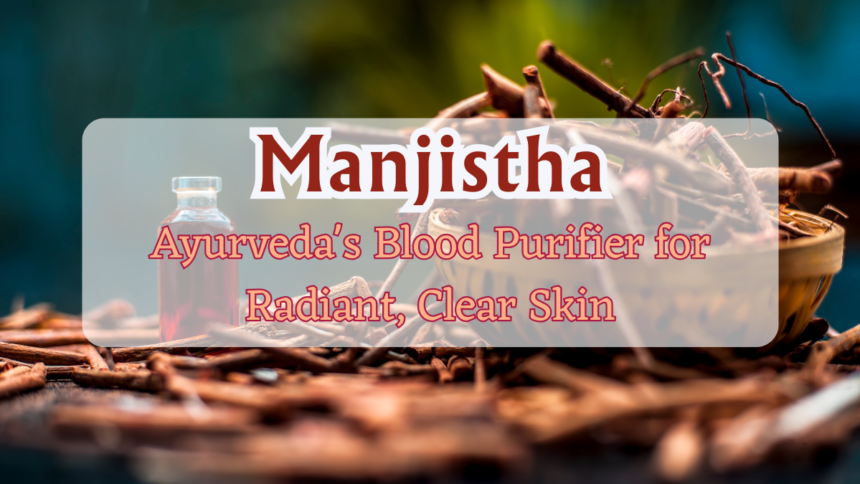
Manjistha Rubia cordifolia, family Rubiaceae (the same family as coffee and gardenia) is a perennial, scrambling vine native to the Himalayan regions of India, Nepal, and China, found growing at altitudes of 1,000–3,750 metres in forest margins, shaded rocky slopes, and hedgerows across its native range. The plant is recognisable by its whorled leaves (typically four per node), small, star-shaped, yellowish-white flowers, and most distinctively its roots and lower stems, which are coloured a rich, deep red-orange that immediately signals the presence of the anthraquinone pigments that constitute its primary bioactive compounds.
This red colouration is not merely visually distinctive it is pharmacologically significant. The red pigments of Manjistha are anthraquinones and their glycosides: rubiadin, munjistin, purpurin, pseudopurpurin, and related compounds that have been studied for their anti-inflammatory, antioxidant, tyrosinase-inhibiting (pigmentation-reducing), and immunomodulatory properties across a substantial body of pharmacological research. The traditional name Manjistha derives from the Sanskrit root for “bright red” or “very bright,” directly referencing this characteristic colouration and the traditional Ayurvedic logic that the red-rooted plant with affinity for blood (Rakta dhatu, which is also red) was particularly appropriate for treating conditions involving blood and the skin that blood nourishes.
In Ayurvedic classification, Manjistha is described as having Tikta (bitter), Kashaya (astringent), and Madhura (sweet) Rasa, Guru (heavy) and Ruksha (dry) Guna, Ushna Virya (heating potency), and Madhura Vipaka (sweet post-digestive effect). It is classified as the premier herb for Rakta Shodhana (blood purification), Varna Prasadana (skin complexion improvement), and Rakta Stambhana (controlling blood-related disorders) classical therapeutic categories that, when examined through modern pharmacology, reveal genuine mechanistic correlates rather than merely symbolic associations.
Classical texts specifically indicate Manjistha for Kushtha (skin disorders broadly), Visarpa (herpes and spreading skin infections), Vrana (wounds and ulcers), Raktapitta (bleeding disorders), and Kamala (jaundice with skin manifestations) a clinical spectrum that, translated into modern dermatological and hepatological terms, corresponds to conditions involving immune-inflammatory skin pathology, microbial skin infections, impaired wound healing, coagulation disorders, and the skin manifestations of liver dysfunction.
The Phytochemistry of Manjistha: The Anthraquinone Foundation
Manjistha’s pharmacological activity rests on a phytochemical profile dominated by anthraquinone compounds and their glycosides a compound class whose pharmacological characterisation has revealed mechanisms directly relevant to each of Manjistha’s primary clinical applications.
Rubiadin the primary monomeric anthraquinone in Manjistha has demonstrated significant anti-inflammatory activity through NF-κB inhibitory pathways, direct tyrosinase inhibitory activity (the enzyme responsible for melanin synthesis in melanocytes, and therefore a direct target for hyperpigmentation management), and antimicrobial activity against skin-relevant pathogens. Rubiadin’s tyrosinase inhibitory activity has been compared favourably to kojic acid, one of the most widely used cosmetic skin-brightening compounds, in pharmacological assay systems.
Munjistin and pseudopurpurin two related anthraquinone compounds found in significant concentrations in Manjistha roots contribute additional anti-inflammatory, antioxidant, and, uniquely among the anthraquinone fraction, specific documented effects on lymphatic function and capillary permeability that provide the mechanistic basis for Manjistha’s lymphatic-supportive applications discussed below.
Purpurin and xanthopurpurin provide the characteristic red pigment alongside documented anti-inflammatory, antitumour, and antioxidant activity, with purpurin’s specific inhibitory effects on platelet aggregation providing a mechanism relevant to the circulatory and anti-thrombotic applications in classical Ayurvedic formulations.
Tannins including gallic acid and its derivatives provide substantial antioxidant activity, antimicrobial properties (relevant to Manjistha’s traditional application in infective skin conditions), and astringent tissue-firming effects consistent with the Kashaya Rasa attributed to the herb in classical classification.
Iridoid glycosides contribute anti-inflammatory and hepatoprotective activity, extending Manjistha’s pharmacological relevance into the liver-skin connection discussed in the skin health from within article in this series.
The Rakta Shodhana Concept: What “Blood Purification” Actually Means
Understanding Manjistha’s skin health applications requires first understanding what Ayurveda means by Rakta Shodhana blood purification because this classical concept, while sometimes dismissed as pre-scientific metaphor, maps onto modern physiological realities with surprising specificity.
In the Ayurvedic framework, Rakta (blood tissue the second Dhatu in the sequential tissue nourishment chain discussed in the Understanding Ojas article in this series) is understood not merely as the fluid that transports oxygen and nutrients, but as the tissue specifically responsible for the vitality and clarity of the skin. The skin is considered a direct expression of Rakta’s quality when Rakta is pure, balanced, and uncontaminated by Ama, the skin reflects this in its clarity, evenness, and glow; when Rakta carries excess Pitta, accumulated Ama, or toxins from insufficient liver elimination, these imbalances manifest directly on the skin as acne, hyperpigmentation, inflammation, and uneven tone.
The Rakta Shodhana application of Manjistha therefore targets not the skin directly but the quality of the blood and lymph that nourishes it reducing the circulating inflammatory mediators, hormonal metabolites, and toxic compounds that the skin expresses when they accumulate beyond the liver’s and lymphatic system’s capacity to process and eliminate them. This is, in functional terms, precisely the gut-skin axis and liver-skin connection described in the skin health from within article in this series expressed in different vocabulary but pointing at the same mechanistic reality.
Modern pharmacological research validates this framework directly: Manjistha’s anthraquinone compounds reduce circulating inflammatory cytokines (the “Pitta in Rakta” of classical description), enhance hepatic detoxification function (supporting the liver’s capacity to process metabolic waste before it reaches circulation), and support lymphatic clearance of immune complexes and inflammatory byproducts (addressing the lymphatic congestion that classical Ayurveda associates with persistent skin inflammation).
Manjistha for Hyperpigmentation: The Tyrosinase Mechanism
Hyperpigmentation whether post-inflammatory (resulting from acne, eczema, or other inflammatory skin conditions), melasma (hormonally triggered, as in the woman described in this article’s opening), or sun-induced (solar lentigines and uneven tanning) is driven by overactive melanin production in melanocytes, regulated primarily by the enzyme tyrosinase, which catalyses the rate-limiting steps in the melanin synthesis pathway.
Manjistha’s anthraquinones particularly rubiadin and, to a lesser degree, purpurin have demonstrated direct tyrosinase inhibitory activity in multiple in vitro studies, with IC50 values (the concentration required to achieve 50% enzyme inhibition) comparable to those documented for kojic acid and alpha-arbutin, two of the most widely used topical hyperpigmentation treatment actives in contemporary dermatology. This direct enzyme inhibitory mechanism provides the pharmacological basis for Manjistha’s traditional application in skin complexion improvement and hyperpigmentation reduction both through internal (blood purification, supporting reduced upstream inflammatory triggering of melanocyte overactivation) and topical application routes.
For post-inflammatory hyperpigmentation specifically the brown marks that remain after acne lesions resolve, representing the skin’s melanocyte response to the inflammation that the acne lesion caused Manjistha addresses both the upstream cause (reducing the inflammatory environment that triggers melanocyte hyperactivation) and the downstream expression (directly inhibiting the tyrosinase responsible for melanin overproduction), providing a genuinely comprehensive anti-hyperpigmentation mechanism that topical tyrosinase inhibitors alone cannot match.
Manjistha for Acne: Addressing the Internal Inflammatory Environment
The acne applications of Manjistha have been addressed in the skin health from within article in this series, but warrant specific expansion in the context of this dedicated profile to clarify the distinct mechanisms through which Manjistha addresses the internal inflammatory environment that drives acne pathophysiology.
Androgenic hormones particularly testosterone and its more potent derivative dihydrotestosterone (DHT) drive sebaceous gland hyperactivity and the excess sebum production that creates the anaerobic environment in which Cutibacterium acnes proliferates. Manjistha’s traditional application in conditions involving hormonal-driven skin manifestations has an interesting mechanistic correlate in research: the herb’s documented effects on the hepatic clearance of steroid hormones particularly oestrogen and androgen metabolites through enhanced hepatic glucuronidation activity, suggest a mechanism by which Manjistha may reduce circulating androgen levels available to stimulate sebaceous glands, addressing hormonal acne through liver-mediated hormone clearance rather than through direct anti-androgen receptor activity.
The direct anti-inflammatory activity of Manjistha’s anthraquinones reducing NF-κB-mediated cytokine production in skin tissue addresses the inflammatory component of acne lesion development independently of the hormonal mechanism, providing complementary anti-acne activity through both endocrine and inflammatory pathways simultaneously.
Manjistha and the Lymphatic System
One of the most clinically significant and most frequently underappreciated dimensions of Manjistha’s pharmacological profile is its documented support for lymphatic function the circulatory system parallel that collects interstitial fluid, immune cells, and metabolic waste from peripheral tissues and returns them to the systemic circulation for processing and elimination.
Lymphatic congestion impaired flow of lymphatic fluid due to various causes including chronic inflammation, sedentary lifestyle, and lymphatic endothelial dysfunction contributes to the accumulation of immune complexes, inflammatory byproducts, and metabolic waste in the interstitial space surrounding tissues including the skin, where this accumulated material can drive chronic local inflammation and impair the skin’s normal regenerative processes.
Munjistin and related Manjistha compounds have demonstrated specific effects on lymphatic endothelial function and capillary permeability in pharmacological research reducing the capillary leakage that contributes to lymphatic congestion while enhancing lymphatic flow providing a mechanistic basis for Manjistha’s traditional role as a lymph-clearing herb and its application in conditions classically described as involving lymphatic stagnation with skin manifestations.
Abhyanga (Ayurvedic self-massage) performed with Manjistha-infused oils is specifically described in classical texts as supporting both superficial and deep lymphatic drainage a practice that combines Manjistha’s pharmacological lymphatic support with the mechanical lymphatic drainage produced by massage, creating a synergistic approach to lymphatic health that is mechanistically coherent from both Ayurvedic and modern physiological perspectives.
Manjistha in Classical Formulations
Manjistha’s most prominent classical formulations include Mahamanjisthadhi Kashaya (a complex decoction combining Manjistha with multiple complementary blood-purifying and anti-inflammatory herbs for chronic skin conditions and inflammatory disorders), Sarivadyasava (a fermented liquid preparation for skin diseases), and Khadirarishta (a fermented formulation for skin disorders combining Manjistha with Khadira bark and other skin-specific herbs).
Topically, Manjistha appears in numerous classical face pack (Mukha Lepa) formulations combined with sandalwood (for its cooling, skin-brightening, and antimicrobial properties), turmeric (for its anti-inflammatory and antimicrobial properties), and red sandalwood (for its astringent and complexion-improving properties) combinations whose synergistic effects on skin clarity address multiple mechanisms simultaneously.
Practical Use: Internal and External Application
Internal use Manjistha churna: 1–3g twice daily with warm water or milk. For skin applications, consistent daily use over a minimum three-month period is required for meaningful results, reflecting the gradual, cumulative nature of blood purification and the tissue-level changes involved in addressing hyperpigmentation and chronic skin inflammation.
Standardised extract capsules: 500–1,000mg twice daily, most appropriate for therapeutic applications targeting specific skin conditions.
Topical Manjistha face pack: Manjistha powder (1–2 teaspoons) combined with rose water, honey, or plain yoghurt to form a paste, applied for 15–20 minutes before rinsing. The direct topical tyrosinase inhibitory activity complements the systemic blood purification mechanism when both routes are used simultaneously.
Manjistha oil (Manjistha-infused sesame or coconut oil) for Abhyanga: particularly relevant for lymphatic support and skin health maintenance as a regular daily practice.
Safety Profile
Manjistha’s safety profile at standard doses is generally favourable. Consideration include: its Ushna Virya (heating potency) may require balancing with cooling herbs or dietary modifications in highly Pitta-dominant individuals; potential drug interactions with anticoagulant medications through the platelet-modulating activity of purpurin; and pregnancy caution given the uterotonic potential of anthraquinone compounds at high doses standard culinary use is generally considered acceptable, but therapeutic supplemental doses warrant medical guidance during pregnancy.
The Honest Bottom Line
Manjistha’s pharmacological profile provides a genuinely compelling explanation for why this herb has remained at the centre of Ayurvedic dermatological practice for over two thousand years. Its anthraquinone-mediated tyrosinase inhibition addresses hyperpigmentation through a mechanism comparable to modern cosmetic actives. Its anti-inflammatory NF-κB inhibitory activity reduces the inflammatory environment that drives acne and post-inflammatory hyperpigmentation. Its hepatic detoxification enhancement addresses the liver-skin axis that skin health from within articles throughout this series have characterised. Its lymphatic support removes the circulatory congestion that chronic skin inflammation creates and perpetuates.
The woman in this article’s opening story was right to be frustrated with four years of surface-only intervention. Her skin was reflecting something internal. Manjistha addressed it internally. And the radiance that followed was not a cosmetic effect. It was the skin expressing the clarity of the blood that nourishes it.
Did this comprehensive guide to Manjistha help you understand why skin health requires an inside-out approach? Share it with someone whose persistent skin issues have resisted topical treatment alone. Leave a comment with your experience with Manjistha or questions about incorporating it into your skin health protocol, or subscribe to our newsletter for more rigorously researched content connecting Ayurvedic tradition to modern dermatological science.