




Anxiety and Heart Palpitations
We’ve all had that moment. You’re finally settling into bed, or perhaps you’re just sitting in a meeting, when suddenly, you feel it. A strange “thump,” a sudden fluttering, or the sensation that your heart is trying to win a marathon while you’re perfectly still. Your hand instinctively goes to your chest. Your mind immediately starts racing faster than your pulse: Is something wrong? Am I having a heart attack?
If you’ve experienced this, you aren’t alone. Heart palpitations are one of the most common—and arguably the most terrifying—physical symptoms of stress. It is the moment where the “mental” feeling of anxiety becomes undeniably physical. But here is the good news: while they feel like a major emergency, most palpitations are simply your body’s over-enthusiastic response to a perceived threat.
In this deep dive, we’re going to demystify the connection between Anxiety and Heart Palpitations, providing an in-depth look at why your heart “skips” and sharing essential Tips to “Anxiety and Heart Palpitations” management to help you find your rhythm again.
1. The Biology of the “Skip”: Why Your Heart Fluttering Isn’t a Glitch
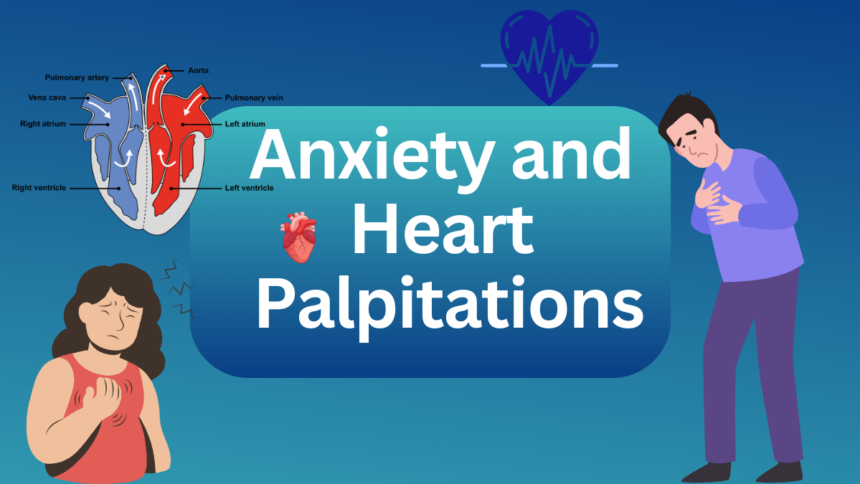
To understand your heart, you have to understand your nervous system. When you are anxious, your body enters “Fight or Flight” mode. This triggers the release of hormones like adrenaline and cortisol.
Adrenaline is like high-octane fuel. It tells your heart to pump harder and faster to get blood to your muscles so you can run from a predator. In the modern world, that “predator” is often an unpaid bill or a social media notification. Because you aren’t actually running anywhere, that extra energy has nowhere to go. The result? You feel every single beat. You notice the “thud” against your ribs, and your heart might even add a few extra beats (known as premature ventricular contractions, or PVCs) to the mix.
Insight: It’s not that your heart is broken; it’s that your internal “security guard” is screaming “fire!” when someone just lit a candle.
2. Anxiety vs. Cardiac Issues: When to Listen to the Alarm
This is the question that keeps people searching for answers at 3:00 AM. How do I know if this is just stress? While a medical professional is the only one who can give you a clean bill of health, there are patterns. Anxiety and Heart Palpitations typically occur in short bursts. They often coincide with a surge of worry or a panic attack. If you notice that your heart settles down once you’re distracted or practicing deep breathing, it’s a strong indicator that anxiety is the driver.
However, if your palpitations are accompanied by fainting, severe shortness of breath, or pain that radiates to your arm or jaw, it is vital to seek immediate medical attention. Building authority over your health means knowing when to use a breathing exercise and when to call a professional.
3. Modern Holistic Practice: Enhancing Patient Care Through Tracking
In 2026, we are finally seeing a shift toward a more integrated, holistic practice. We no longer just treat the mind or just treat the body. We treat the connection between them.
Innovative patient care now utilizes technology to bridge the gap. For instance, many people now use wearable devices to track their heart rate variability (HRV). This data-driven approach allows for better follow-ups with your doctor. Instead of saying, “I felt weird last Tuesday,” you can show a digital log of exactly when your heart spiked and what your stress levels were at the time. This takes the mystery out of the “thumping” and allows you to address the root cause—your stress response—rather than just the symptom.
4. Essential Tips to “Anxiety and Heart Palpitations” Relief
If you feel your heart start to flutter right now, try these three evidence-based strategies to bring yourself back to center.
The Vagus Nerve Reset
The vagus nerve is the “off switch” for your stress response. You can stimulate it by splashing ice-cold water on your face or by humming a low-frequency tune. This sends a physical signal to your brain that the “emergency” is over, which naturally slows your heart rate.
The “4-7-8” Breathing Technique
Shallow breathing tells your heart to speed up. Deep, rhythmic breathing tells it to slow down.
- Inhale for 4 seconds.
- Hold for 7 seconds.
- Exhale slowly through your mouth for 8 seconds. The long exhale is the most important part; it triggers the parasympathetic nervous system to take over.
Hydration and Electrolytes
Sometimes, anxiety just highlights a physical vulnerability. If you are dehydrated or low on magnesium or potassium, your heart is more likely to experience “skipped” beats. One of the simplest Tips to “Anxiety and Heart Palpitations” is to ensure you’re drinking enough water and getting adequate minerals through your diet.
5. Lifestyle Shifts: Lowering the Volume of the Drum
If you want to stop the palpitations from happening in the first place, you have to look at your daily “baseline.”
- Audit Your Stimulants: Caffeine and nicotine are like throwing gasoline on an anxious fire. If you are prone to heart fluttering, consider switching to decaf or herbal teas.
- Prioritize Sleep: A tired heart is a cranky heart. Lack of sleep makes your nervous system much more reactive to minor stresses.
- Mindfulness and Grounding: Using the 5-4-3-2-1 method (naming 5 things you see, 4 you can touch, etc.) helps pull your focus away from your internal heartbeat and back to the world around you.
Conclusion: You Are the Pilot, Not the Passenger
Anxiety and Heart Palpitations are a scary combination, but they don’t have to control your life. By understanding the biology of the “thump,” utilizing modern tools to track your health, and practicing grounding techniques, you can start to see these sensations for what they are: a signal, not a sentence.
Remember, your heart is a powerful, resilient muscle. It’s been beating for you since before you were born, and it knows how to find its way back to a steady rhythm. Be patient with yourself, keep your toolkit of Tips to “Anxiety and Heart Palpitations” ready, and don’t be afraid to reach out for support.
What’s the one thing that always helps you feel grounded when you’re stressed? Share your thoughts in the comments below—your tip might be exactly what someone else needs to read today. If you found this guide helpful, share this article or subscribe to our newsletter for more weekly insights on finding calm in a chaotic world.

