









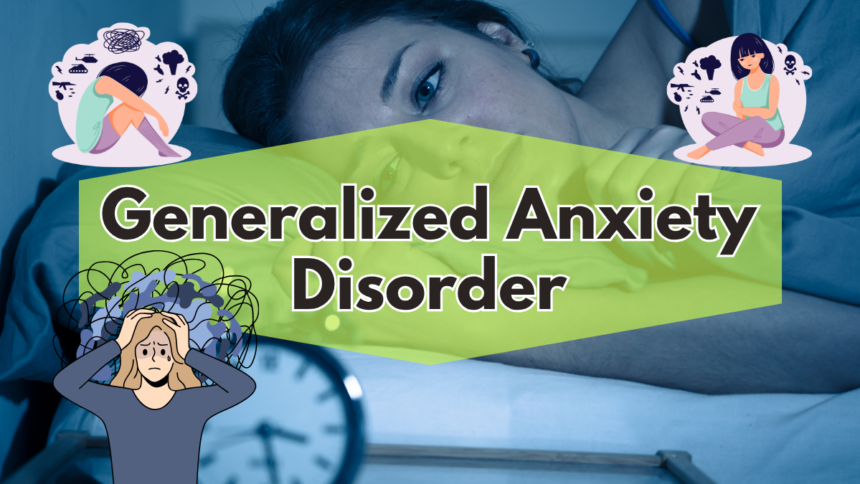
Generalized Anxiety Disorder
We’ve all experienced that feeling of having 50 browser tabs open in our minds, three of which are playing loud music we can’t find, and one that keeps flashing an “Error” message. For most people, that feeling eventually goes away once a deadline passes or a problem is solved. But for someone living with Generalized Anxiety Disorder (GAD), that mental background noise never quite hits the “mute” button.
Living with GAD is like having a smoke detector in your brain that is so sensitive it goes off not just for a fire, but for a candle, a toaster, or even someone just thinking about a match. It is an exhausting, persistent state of “high-alert” that can make even the most mundane Tuesdays feel like a trek through a minefield.
If you’re tired of the constant “what-if” loops, it’s time to look under the hood. Understanding the mechanics of your worry is the first step toward reclaiming your peace. Let’s dive into the reality of the condition and explore practical, evidence-based Tips to Generalized Anxiety Disorder management.
What GAD Really Is (And Isn’t)
It’s important to clarify: GAD isn’t just “stressing out.” Stress is a response to a specific, external pressure (like a project launch or a bill). GAD is different. It is characterized by excessive, uncontrollable worry about a variety of things—health, work, family, or even just the “vibe” of the day—lasting for at least six months.
The hallmark of GAD is that the worry is disproportionate to the actual event. You aren’t just worried you’ll be late; you’re worried that being late will lead to being fired, which will lead to losing your home, which will lead to a total life collapse. This is called “catastrophizing,” and it’s the fuel that keeps the GAD engine running.
The Physical Toll: More Than Just “In Your Head”
One of the biggest misconceptions about Generalized Anxiety Disorder is that it’s purely mental. Your brain and body are on a two-way street. When your mind is in a state of chronic worry, it pumps out cortisol and adrenaline as if you were in physical danger.
Over time, this “chemical bath” leads to physical symptoms:
- Muscle Tension: That “clenched” feeling in your jaw or the tightness in your shoulders and lower back.
- Gut Issues: The “butterflies” that feel more like a swarm of angry bees.
- Fatigue: You’re exhausted because your nervous system is essentially running a marathon while you’re just sitting at your desk.
- Sleep Disturbances: The “2:00 AM wake-up call” where your brain decides it’s the perfect time to review every mistake you’ve made since 2014.
Essential Tips to “Generalized Anxiety Disorder” Management
Navigating life with GAD requires a multi-pronged approach. It’s not about “stopping” the thoughts—it’s about changing your relationship with them. Here are the most effective Tips to Generalized Anxiety Disorder support to help you find your center.
1. The “Worry Window” Technique
Trying to “not worry” is like trying to not think of a pink elephant. Instead, give your worry a dedicated time slot.
- The Practice: Set aside 15 minutes at, say, 4:00 PM. During this time, you are allowed to worry as much as you want. Write it all down. When the 15 minutes are up, tell yourself, “I’ve handled that for today. If a new worry pops up, it goes into tomorrow’s window.” This creates a boundary that prevents worry from bleeding into your entire day.
2. Cognitive Reframing (The “Courtroom” Method)
When a catastrophic thought pops up—“Everyone hates my work”—put that thought on trial.
- The Practice: Ask for evidence. “What is the actual proof that everyone hates my work?” Then, look for counter-evidence. “My manager gave me a positive review last week.” Reframing the thought from “Everyone hates it” to “I am feeling insecure today, but my track record is solid” takes the power away from the anxiety.
3. The “Biological Buffer”
As we’ve discussed in our guides on [Magnesium for Anxiety] and [Vitamin D], your physical chemistry dictates your mental resilience.
- The Practice: Ensure you aren’t running on “empty.” Chronic worry burns through magnesium and B-vitamins. Supporting your nervous system with proper nutrition and sensible supplementation acts as a buffer, making it harder for the “panic switch” to get flipped.
4. Digital Boundaries
For the modern professional, notifications are the enemy of peace. Every “ping” is a mini-spike in cortisol.
- The Practice: Implement a “Digital Sunset.” Turn off work notifications at a set time each night. If you’re a developer or marketer, the urge to check “one last thing” is strong—but your brain needs the “off-line” time to clear out the day’s stress chemicals.
Addressing Common Concerns: “Am I Broken?”
A common question people ask is, “Why can’t I just be normal?” It’s important to understand that GAD often has a genetic component and is influenced by your environment. You aren’t “broken”; your brain is simply “over-tuned” for survival. In an ancestral environment, your ability to spot potential threats would have made you a vital member of the tribe. In the 21st century, it just makes you really tired.
According to the Anxiety and Depression Association of America (ADAA), GAD affects 6.8 million adults in the U.S. alone. You are in very good, albeit very stressed, company.
The Physical-Mental Connection: A Loop of Relief
If you are managing physical recovery—perhaps dealing with chronic tension or recovering from a procedure—your Generalized Anxiety Disorder will likely be higher. Pain is a stressor. By using techniques like Box Breathing or progressive muscle relaxation, you are sending a physical signal to your brain that it is safe to let go. When the body relaxes, the mind often follows.
Summary of Management Strategies
| Strategy | Goal | Frequency |
| Worry Window | Contain the anxiety | Daily (15 mins) |
| CBT Reframing | Challenge the “What-Ifs” | As needed |
| Breathwork | Manual nervous system override | 3–5 minutes, 3x daily |
| Supplementation | Rebuild biological resilience | Daily (with Dr. approval) |
Conclusion: Reclaiming Your Narrative
Living with Generalized Anxiety Disorder doesn’t mean you are destined for a life of constant panic. It means you have to be a bit more intentional about your “mental hygiene” than the average person. By incorporating these Tips to Generalized Anxiety Disorder, you are slowly but surely “re-tuning” that oversensitive smoke detector in your brain.
There will still be days where the noise is loud. But over time, you’ll find that you have the tools to dial it back down. You are more than your worries, and your “what-ifs” don’t get to write the ending of your story.
Take the Next Step
- Subscribe to our newsletter for more in-depth guides on mental performance, digital wellness, and evidence-based health.
- Leave a comment: What is your biggest “what-if” trigger, and how do you handle it?
- Share this article: If you know someone who is struggling to “switch off,” send this their way.